
Ford Cortina - More class than your mum
- October 16, 2026, 09:43:47 AM
- Welcome, Guest

News:
FordCortina.com.au is now a restored read-only historical archive. Browse the Forum, Gallery and Australian Models; posting, registration and account changes are disabled.
- Home »
- Cortinas in the Media »
- Australian Models
Australian Ford Cortina: Six Local Stories
Six generations. One very Australian story.
From the early Mk1 GT through to the final TF, these are the six Cortinas that define the local story: Mk1, Mk2, TC, TD, TE and TF. This is a browse-only heritage guide built around the original FordCortina gallery — not a replacement gallery, not a modern rebuild, and not a claim that every surviving car left the factory the same way.
Australian body and performance choices: the two-door belongs to the early Mk1 and Mk2 chapter. From TC through TF, the local story moves to four-door sedans and wagons. The sporting side also ran right through the series, from the Mk1 GT and GT500 and the Mk2 GT/L-pack, through XLE and later S-Pak, X-Pak and other period packages. Exact names, engines, equipment and availability changed with each series and model year — which is why an individual car should always be checked against its compliance plate and period Australian literature.
Every card starts with an original legacy photograph. Open the picture for its preserved gallery record, then keep digging through the original album for the full story.
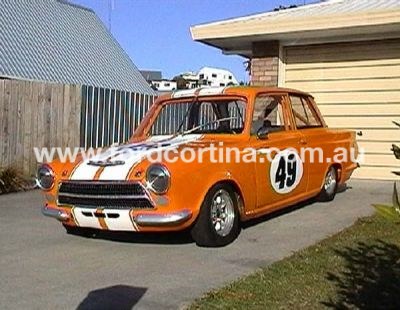 Original FordCortina gallery photograph: Mk1 Racer.
The Mk1 started the Australian Cortina story as a compact, light rear-drive Ford with real motorsport bite. The later Mark 1b brought the wider grille, round instruments, front discs and Aeroflow ventilation. Locally, the GT and GT500 gave the little Cortina a proper competition reputation — including Ian Geoghegan’s 1964 Touring Car Championship win. This is the early car that showed an Australian Cortina could be small, sharp and seriously quick.
- Australian Mark 1b facelift from October 1964.
- GT and GT500 are Australian performance landmarks.
- Individual body, engine and trim details must be confirmed against the car.
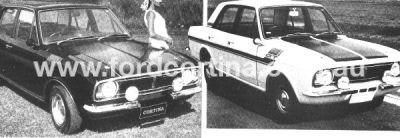 Original FordCortina gallery photograph: Mk2 GT.
Australian Mk2 production began in 1967 and gave the Cortina more presence without losing its direct, compact feel. Local 220, 240, 440, GT and L-pack versions tell a story that is not simply the UK Mk2 copied here. The 1969 GT sharpened the look with bonnet anti-glare panels, stripes, driving lights, wider radial tyres, mirrors and split bumperettes. With cross-flow four-cylinder power arriving during the run, the Mk2 became a proper Australian street-and-strip favourite.
- Locally produced from August 1967.
- Australian 220, 240/440, GT and L-pack variants.
- 1969 GT received a distinct local style and equipment package.
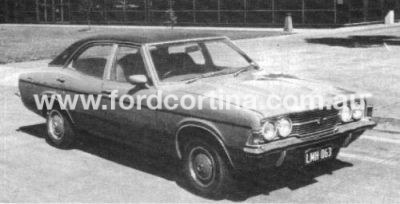 Original FordCortina gallery photograph: TC XLE.
The TC took the Cortina into new territory. Australia got L and XL sedans, the first local Cortina wagons, and four-cylinder 1.6 or 2.0 litre choices. Then Ford Australia made the move enthusiasts still talk about: Falcon-derived 200 and 250 sixes. From 1972, the six-cylinder TC brought quad headlights and the bonnet power bulge — an unmistakable local answer to anyone who thought a Cortina had to stay mild.
- Locally built at Broadmeadows.
- L and XL sedans plus the first Australian Cortina wagons.
- Falcon 200 and 250 sixes introduced from September 1972.
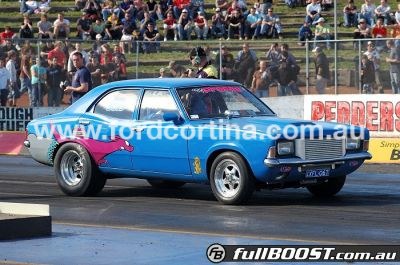 Original FordCortina gallery photograph: TD.
The TD refined the Australian six-cylinder formula without sanding off its attitude. A new dash, plastic grille, revised braking and suspension, better ventilation and L, XL or XLE trim gave it a tougher late-seventies identity. The 3.3 and 4.1 litre Falcon sixes remained the headline act, still marked out by quad lights and the power bulge. A TD is more than a facelift — it is one of the clearest examples of Ford Australia turning an overseas platform into something very local.
- Built in the mid-1970s before the TE arrived.
- Available with 3.3 and 4.1 litre Australian Falcon sixes.
- XLE added a higher grade of local trim and equipment.
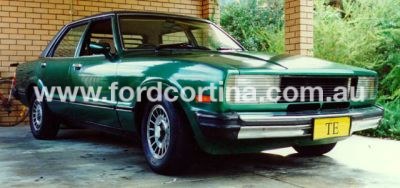 Original FordCortina gallery photograph: TE Cortina GL.
The TE arrived with the angular Taunus-based shape that made the Cortina look fresh for the late seventies, but the Australian version had its own muscle. Buyers could choose the 2.0 four, a 3.3 crossflow six or the 4.1 six in the flagship Ghia. The big engines demanded local engineering: a taller bonnet, revised front suspension and brake changes. Sedan or wagon, mild or wild, the TE is where the Australian Cortina became a convincing show-car and pro-street canvas.
- Introduced in Australia in 1977.
- 2.0 four, 3.3 six and 4.1 six options by variant.
- The flagship Ghia could carry the 4.1 litre crossflow six.
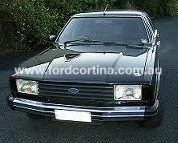 Original FordCortina gallery photograph: TF Cortina.
The TF closed the Australian Cortina chapter in 1981. It carried forward the hard-edged TE shape and the uniquely Australian idea that a Cortina could run Falcon-derived six-cylinder power. It was the final local revision of a model family that had grown from a light four-cylinder family car into a tough sedan or wagon with genuine street presence. Every surviving TF has its own story — stock, Ghia, modified, drag car, tow rig or family survivor — and that is exactly what this archive is here to keep visible.
- Final Australian revision, launched in 1980.
- Australian production concluded in 1981.
- Six-cylinder cars retain the local Cortina power-bulge and quad-headlight character.
Read the preserved historical Cortinas in the Media articles